Part 1
The boardroom floated above the city like a room built to forget the people below it.
Wide glass walls held the cold skyline in place, while daylight slid across the long walnut table and broke into sharp reflections beneath the silver water carafes and untouched wine glasses.
Black leather chairs faced one another in perfect order, and every surface looked expensive enough to turn silence into a rule.
At the far left end of the table sat Evelyn Brooks, her back straight, her hands folded over a worn brown leather notebook that did not belong with the polished glass and moneyed wood around it.
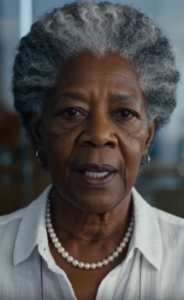
She was sixty-four, with silver-gray curls, deep brown skin, and a calm face lined by decades of listening without being invited to speak.
Her white cotton blouse was crisp but plain, and her reading glasses hung from her collar like something practical rather than decorative.
Across from her, Charles Whitmore stood at the head of the table with a wine glass in his right hand and a smile that had been practiced in rooms where no one told him no.
Three board members sat around him, already amused before he opened his mouth.
They had seen Evelyn in the hallways for years.
They had seen her carrying trays, opening doors, replacing empty cups, wiping coffee rings from polished surfaces while they discussed people as if names on payroll sheets were not lives.
None of them had ever asked why she remembered everything.
Charles lifted the glass toward her.
“To the woman who spent thirty years bringing us coffee,” he said.
The board members chuckled.
One man hid his laugh behind his hand, and another glanced at Evelyn as if expecting her to lower her eyes.
She did not.
Her gaze stayed on Charles with a stillness that made the laughter thin at the edges.
The city moved soundlessly beyond the windows, pale and distant, while dust turned slowly in the daylight above the table.
Charles took a small sip, pleased with himself.
“You can leave the notebook with reception if this is about your retirement papers,” he added.
Evelyn breathed once through her nose.
It was the smallest movement in the room, yet it changed something.
Her right hand slid the brown notebook forward until it rested in the center of the table, directly between her and Charles.
The leather was cracked at the corners, darkened where years of fingers had held it, and too ordinary to frighten anyone who did not understand how secrets age.
The laughter faded another inch.
Evelyn opened the notebook slowly.
The pages rustled with an old dry sound, and the ink inside remained hidden from where the men sat.
Still, Charles stopped smiling.
Part 2
Evelyn did not look down at the pages.
She did not need to.
For thirty years, the company had taught her which men whispered when they lied, which women lowered their voices before signing away another person’s future, and which names disappeared from the meeting schedule just before a scandal was buried.
She had carried coffee into rooms where bonuses were built from unpaid labor.
She had poured water while executives joked about investigations they had already bought their way around.
She had stood beside the wall, invisible enough to hear everything and old enough to understand what the young feared to say aloud.
Charles shifted his glass from one hand to the other.
“What is this?” he asked, but the confidence in his voice had lost its polish.
Evelyn turned one page with a careful finger.
“Thirty years, I brought you coffee,” she said.
Her voice was low, steady, and plain.
“Thirty years, I heard every secret.”
One of the board members stopped leaning back in his chair.
Another looked toward the door, then quickly back at the notebook.
Evelyn turned another page.
“Thirty years, I wrote everything down.”
The words settled over the walnut table like dust no one could wipe away.
Charles set his wine glass down too carefully.
The base touched the wood with a tiny click that sounded louder than it should have.
“You expect us to believe you kept some diary of office gossip?” he said.
Evelyn’s face did not change.
“I kept dates, rooms, names, payments, threats, and who laughed afterward.”
The boardroom went still.
No one chuckled now.
The man nearest the windows reached for his water and missed the carafe by an inch.
Charles looked at the notebook as if it had begun to breathe on the table.
“You should be very careful, Evelyn,” he said.
The warning was meant to restore the old order, but it landed weakly.
For the first time, the men around the table saw that she had not come to beg for permission, severance, apology, or mercy.
She had come to deliver a verdict.
Evelyn closed the notebook with a firm thud.
The sound moved through the table and into every glass.
Charles jerked upright too fast.
Both of his hands hit the polished wood, and the wine glass tipped sideways.
Dark red liquid spread across his side of the table, crawling around his fingers and toward the silver tie that dipped near the edge.
He did not notice the stain at first.
His eyes were fixed on the brown leather cover.
“What do you want?” he asked.
That was when Evelyn finally allowed the smallest breath to leave her nose.
Not a laugh.
Not triumph.
Only the sound of someone who had waited long enough to watch fear arrive on schedule.
“I wanted to see whether you would remember my name before I used yours,” she said.
Charles’s jaw tightened.
A board member whispered something under his breath, but no one answered him.
Beyond the glass walls, traffic moved in silent threads far below.
Inside the room, the spilled wine kept widening.
Evelyn placed one hand flat on the notebook, steady as a seal.
“And the journalist is waiting for this notebook outside.”
Charles’s face broke first in the eyes.
The pale blue certainty flickered into calculation, then panic, then a naked fear he could not hide behind money quickly enough.
His mouth opened, but no useful sentence came out.
One of the board members pushed his chair back an inch and stopped, as if movement itself might become evidence.
Another stared at the closed notebook, already counting which secrets inside belonged to him.
Evelyn remained seated.
She had not raised her voice.
She had not stood.
She had not threatened anyone with anything more dramatic than memory, ink, and timing.
That was enough.
Charles looked toward the door.
For the first time all morning, he seemed to understand that the hallway outside the boardroom was not empty space but a path the truth could use to enter.
“Evelyn,” he said, and now her name sounded different in his mouth.
It sounded like a plea trying to dress itself as authority.
She lifted the notebook from the table and held it against her chest.
The wine continued to spread on his side, red and silent over the polished wood.
No one reached for it.
No one reached for her.
Behind the frosted glass of the boardroom door, a shadow paused.
Then came a quiet knock.
Charles stopped breathing for one full second.
Evelyn looked at him with the same calm expression she had worn when he toasted her as the coffee woman.
Only now, everyone in the room understood which one of them had truly been serving judgment all along.
The door handle began to turn.