PART 1
A hoof struck the stone hard enough to make the courtyard flinch.
Dust leapt from the sunlit tiles and hung in the white heat between the arches.
Sultan rose on his hind legs, black and towering, his front hooves cutting through the air like dark blades that touched no one.
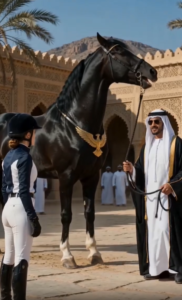
The gold-toned chest plate flashed once across his breast, and the lead rope groaned in Sheikh Omar Al Rashid’s hand.
Behind him, five attendants in white thobes stumbled backward toward the shade, their robes snapping in the wind that came through the palace gate.
Clara Bennett did not move.
She stood to the left of the stallion’s shoulder with dust on her boots, her hands low at her sides, her breath shallow under the collar of her navy-and-white riding jacket.
Fear moved across her face, but it did not own it.
It sharpened it.
Sunlight burned on the palace walls.
Harsh shadows lay under the carved archways.
Beyond the open court, rocky mountains looked close enough to touch and too far away to help.
One of the older attendants swallowed and whispered, almost to himself, “He throws back every hand that comes to own him.”
Clara’s green eyes traveled over the stallion the way a surgeon studies a wound.
She watched the ears first.
Then the shoulders.
Then the white feathering around the hooves that struck and settled and struck again.
Sweat darkened the base of Sultan’s neck.
Foam had not touched his mouth.
The horse was frightened, not broken.
On the right side of the courtyard, Omar stepped forward in his white thobe and black bisht, the gold trim bright against the heat-bleached stone.
His sunglasses hid his eyes.
His jaw did not hide his satisfaction.
He lifted the rope a little, pointed at Clara, and let the pause sit like a blade between them.
“If you can tame this horse…” he said.
The palace seemed to go still.
Even the attendants stopped breathing.
Then his voice landed with a quiet arrogance that felt heavier than a shout.
“I will marry you.”
Sultan reared again behind the words.
Clara did not answer.
She only looked at the horse, then at the man, as if deciding which creature in the courtyard was truly more dangerous.
PART 2
Clara had not come to the desert palace for romance.
She had come because pride had a way of wearing silk and calling itself an invitation.
Three weeks earlier, a sealed card edged in black had arrived at the stable outside Seville where she worked horses no one else had the patience to understand.
It had contained no plea, only an offer to visit Sheikh Omar Al Rashid’s court and witness the black stallion no rider could settle.
Most people around her had heard money when they read it.
Clara had heard a dare.
She almost threw the card away.
Then she remembered another horse, years earlier, a gray mare named Juniper with terrified eyes and a ruined reputation.
A patron had called the mare dangerous.
The stable manager had laughed when Clara said the animal was only afraid.
Clara had chosen silence over argument because she was young, replaceable, and tired of being dismissed.
Two days later, Juniper was sold out of the yard.
Clara never saw her again.
The shame of that decision had stayed with her longer than any bruise, because nothing had actually happened to Clara except that she had learned how expensive cowardice could feel.
That was why she crossed the palace threshold that morning.
Not to impress a man.
Not to become a prize in somebody else’s performance.
She had come because she had once mistaken silence for safety, and she no longer trusted what silence cost.
The front court of Omar’s palace felt built for judgment.
The stone tiles held the sun like stored fire.
Palm shadows trembled over the sand-yellow walls.
A row of carved archways framed the attendants at the rear like witnesses already retreating from testimony.
Sultan stood in the center of it all, immense and glossy, the muscles under his black coat alive with contained force.
The stallion’s nostrils widened toward the open sky.
He was not lashing out at Clara.
He was measuring every movement around him and refusing the pressure he did not trust.
Omar mistook that refusal for drama.
Clara recognized it as intelligence.
The rope fibers twisted in Omar’s grip.
Sunlight flashed off the gold trim of his bisht and the abstract eagle on Sultan’s chest plate.
Under the palace arches, low shadow softened the men behind him until they looked less like attendants than a row of pale doubts.
No one stepped forward.
No one offered help.
They left the space open between Clara and the stallion as if it might become a grave, a wedding aisle, or a courtroom, and none of them wanted responsibility for choosing which.
Omar inclined his head toward her.
“Well?” he asked.
His tone was pleasant.
That made it worse.
“You have a reputation, Miss Bennett.”
“Let us see if it was earned.”
Clara felt the old instinct rise in her chest.
Keep the peace.
Say nothing.
Stand still until a more powerful person decides what your fear means.
Juniper’s gray face passed through her memory with such force that she could almost smell the damp straw of the stable where she had betrayed herself.
She looked back at Sultan.
His right ear kept flicking toward the movement of the attendants.
His left shoulder tightened every time Omar shortened the rope.
The chest plate lay too proudly across him, bright and ceremonial, but one side had shifted just enough to sit wrong against the line of muscle beneath it.
Nothing brutal.
Nothing bloody.
Just enough discomfort, enough noise, enough hands, enough pride pressing in from every direction to turn a noble animal into a spectacle.
Clara swallowed once.
Then she stepped forward.
The attendants recoiled as if courage itself were contagious.
Sultan threw up his head, snorted toward the open courtyard, and struck the stone again.
Clara stopped where his shoulder remained visible to her, careful never to move under the rise of him.
She kept her body upright.
Her hands stayed low.
Her voice, when it came, was quieter than the wind.
“Give him room.”
No one moved.
Omar smiled with only one side of his mouth.
“You give orders quickly.”
“Only when someone is listening,” Clara said.
For the first time, one of the attendants looked at Omar instead of the horse.
That tiny shift changed the balance of the courtyard.
Sultan felt it too.
He came down from the rear without striking forward, black hooves landing hard and clear on the rough tiles.
Dust jumped around the white feathering at his ankles.
Clara did not reach for him.
She studied the line of the neck, the tension in the poll, the flare of the nostrils, the fixed brightness in the eye.
Then she said the one thing no one there expected.
“He is not fighting me.”
The words seemed to pass through the attendants before they reached Omar.
He tilted his head once.
“No?”
“He is fighting ownership,” Clara said.
A gust of wind lifted the hems of the thobes behind him and rattled the palm leaves overhead.
The stallion’s skin quivered where the edge of the chest plate pressed against him.
Clara saw it.
So did Omar, though he understood it a second too late.
That delay belonged to her.
She extended one gloved hand, not to seize, not to force, only to let Sultan see where she was.
The horse’s ears flicked forward.
The courtyard grew so still that even the sound of a robe moving against stone felt loud.
“Loosen the rope,” Clara said.
Omar did not obey.
“If you want him tamed,” he said.
“Earn it.”
The challenge was meant to humiliate her.
Instead it clarified everything.
The palace did not think of Sultan as a living creature.
It thought of him as proof of wealth.
And Omar had made the same mistake with Clara.
He believed danger could be turned into ceremony if he named the price loudly enough.
Clara took one more step, close enough now to see sweat shining along Sultan’s neck like oil in the sun.
Dust had climbed the leather of her boots.
The horse lowered his head by the smallest degree, then raised it again as Omar’s fingers tightened on the rope.
There it was.
Not wildness.
Interference.
Clara looked at Omar at last.
“You do not know the difference between command and trust,” she said.
It was not a loud sentence.
That was why it landed.
One attendant dropped his gaze.
Another took an involuntary step farther back beneath the arch.
Omar removed his sunglasses.
The movement was small.
It felt enormous.
His eyes were darker than Clara expected and far less amused.
“Careful,” he said.
“No,” Clara answered.
“That is how I learned to stop being careful.”
The old shame inside her shifted then, not gone, but no longer in control.
Juniper was years behind her.
This horse was in front of her now.
This insult was in front of her now.
This man, with his gold trim and his certainty, was in front of her now.
If she kept standing in silence, she would be choosing the same cowardice in a different country.
Sultan breathed once against the hot air.
Clara opened her hand to him.
“If I calm him,” she said, still looking at the stallion, “you will not marry me.”
The attendants stared.
Even Omar seemed caught for the first time between offense and curiosity.
“You do not set the terms,” he said.
“I just did,” Clara replied.
The horse shifted closer by half a step, enough for the rope to slacken a fraction before Omar realized it had happened.
That was the real reversal.
Not a victory won by force.
Not a man humiliated into shouting.
A proud animal choosing calm where wealth had failed to purchase it.
Clara kept her hand out.
She could see the tremor in Sultan’s neck easing.
She could see the whole court watching Omar to find out whether power would pull harder or let go.
His grip tightened once.
Then, under the weight of every eye in the courtyard, he loosened it.
No one spoke.
The silence that followed was hotter than the sun.
Clara did not touch the horse yet.
She let the space remain honest.
Trust could not be performed into existence.
It had to arrive on its own feet.
Sultan lowered his head another inch.
The abstract eagle on the chest plate flashed and then went dull in the shifting light.
Far off, beyond the palace walls, something metallic rang in the heat, thin and lonely.
Clara heard her own breathing.
She heard the wind.
She heard the entire court waiting for a future that money could not script.
When the stallion finally leaned toward her open palm, the first surrender in that courtyard had already begun, and no one was completely certain anymore that it belonged to the horse.