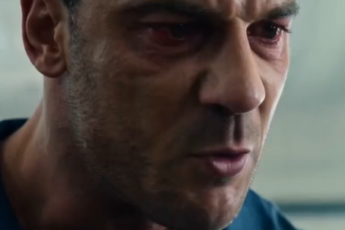
Scroll down for the full video
↓↓↓
PART 1 – THE BURGER HE GAVE AWAY
At the corner of West Mercer and Sixth, the evening traffic moved like a tired river, loud, gray, and impatient. Martin Cole sat on the low stone ledge outside a closed pharmacy with his tool bag between his boots and a plain paper burger box balanced in both hands. His gray work jumpsuit was stiff with dried mud at the knees and marked with dark oil at the sleeves. He had spent twelve hours repairing boiler pipes in a basement that smelled of rust, and the money in his pocket was already divided in his mind: rent first, bus fare second, nothing after that. The cheeseburger in the box was the only thing he had bought for himself all day.
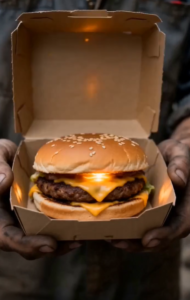
He opened the lid carefully. Warm steam pressed against his face. Melted cheese slipped over the grilled edge of the beef, golden under the streetlight, and for a moment the city became smaller than that one meal. Martin swallowed. His stomach answered before his manners could stop it. He bent his head, ready to take the first bite, when a movement near the wall caught his eye.
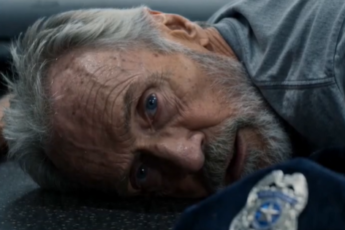
An old man in a worn brown coat sat two yards away, half hidden beside the pharmacy’s delivery door. His silver hair lay flat against his forehead. His hands were rough and folded into each other, not begging, not reaching, only trying not to shake. But his eyes had found the burger box and could not leave it. When Martin looked at him, the old man looked down at once, ashamed of wanting what he had not asked for.
The traffic hummed. A bus hissed at the curb. Martin stared at the burger, then at his own dirty fingers wrapped around the paper box. He had been hungry before. Hunger could make a man count crumbs as if they were coins. He closed the box halfway, not to hide the food, but to stop himself from changing his mind.
He stood, picked up his tool bag, and walked over slowly. Instead of standing above the old man, he crouched until they were level. The old man drew back, expecting a warning, maybe an insult. Martin held out the box with both hands.
“This is all I have. Sir, this is for you.”
The old man stared at him. “For me?”
“Yes,” Martin said, and managed a tired smile. “You need it more. I hope it helps.”
The old man took the box as if it might vanish if he touched it too quickly. His fingers brushed Martin’s knuckles, cold and trembling. For a second neither man moved. The lid rustled in the wind. The burger sat between them like something far larger than food.
“What is your name?” the old man asked.
“Martin. Martin Cole.”
The old man repeated it softly, testing each syllable as if he were placing it somewhere safe. “Martin Cole.”
Martin shrugged, embarrassed by the gratitude in the man’s voice. “Just eat before it gets cold.”
He rose too fast and nearly swayed. The hunger came back sharp, but he forced his boots toward the bus stop. Behind him, the old man opened the box. Martin did not turn around until he reached the corner. When he finally looked back, the old man was holding the burger in both hands, not yet eating, only looking after him with wet eyes. Martin lifted one hand, then disappeared into the crowd.
Years passed with the dull stubbornness of unpaid bills. Martin kept repairing what other people broke: sinks in restaurants, cracked heaters in apartments, office vents that coughed dust over expensive carpets. Kindness did not save him from late notices or sore knees. Sometimes, when he skipped dinner, he remembered the burger and laughed at himself. It had been a foolish thing, he told himself. A decent thing, but foolish. The world did not keep receipts for mercy.
One winter morning, a property manager called him to an address downtown, a tower of glass so high it seemed to belong to the clouds. Martin arrived in the same gray jumpsuit, darker now with age and work, his boots leaving faint prints on the polished lobby floor. Security looked at him twice. A receptionist spoke into a phone, then guided him to a private elevator. No one explained why a leaking vent required a repairman to ride to the top floor.
The elevator doors opened onto silence. Gold-white light spread across marble and glass walls. The air smelled faintly of coffee, paper, and expensive wood polish. Beyond them, the city glittered under a cold sun, indifferent and enormous. A young assistant led Martin down a hallway and stopped before a wide glass door.
“The chairman will see you now,” she said.
Martin frowned. “The chairman? I think there’s been a mistake.”
“No mistake, Mr. Cole. Please go in.”
The door opened. From behind him, the camera would have seen only Martin’s narrow shoulders, the torn knees of his jumpsuit, the worn tool bag in his hand, and beyond him a huge white desk placed before a wall of windows. At the center of that desk sat a plain paper burger box.
PART 2 – THE BOX RETURNS
Martin stopped at the threshold. The paper box was small, almost silly, surrounded by glass, polished metal, and quiet money. Yet it drew his eyes before the city view did. It sat on the spotless white desk exactly where a nameplate might have been, its folded lid facing him, its edges softened as if someone had kept it for years. A brown leather folder lay beside it. A gold pen rested on top.
Behind the desk sat an older man in an elegant black tuxedo and a blue tie. His silver hair was combed neatly back. A gold ring flashed when he placed one hand beside the box. The face was fuller now, stronger, but the eyes had not changed. They were still deep, still careful, still carrying the same quiet gratitude Martin had tried to escape on a dusty sidewalk.
“Come inside,” the chairman said. His voice was calm, not grand. “Do you remember this, sir?”
Martin took three slow steps. His gaze moved from the box to the man’s face, then back again. Recognition did not arrive like lightning. It rose through him slowly, like water filling a cracked room. The pharmacy wall. The cold hands. The question: For me?
“I don’t understand,” Martin said. “You were…”
“Hungry,” the chairman finished. “I was hungry, sick, and very nearly finished. My name is Edward Hale. Back then, no one used it. They stepped around me as if I were a stain on the pavement. You did not.”
Martin looked at his own boots. Mud had dried along the soles. A faint mark showed where he had crossed the clean floor. “Mr. Hale, I only gave you a burger.”
“No,” Edward said gently. “You gave me one human moment when I had begun to believe I no longer qualified for one. That is not small.”
The room held still. The traffic far below was only a muted pulse through the glass. Martin felt exposed under the warm ceiling lights. He had entered expecting a pipe, a vent, a complaint. Instead, the past sat in front of him in a paper box.
Edward touched the lid but did not open it. “I kept the box,” he said. “Not the food, of course. Only the box. My first receipt after deciding I would live one more day.”
Martin gave a weak laugh, because the alternative was to cry. “I thought the world didn’t keep receipts for things like that.”
“People do,” Edward replied.
He opened the brown leather folder. Inside were pages of thick contract paper, but from Martin’s side the text was unreadable, only black lines and formal spacing. Edward turned one page, took the gold pen, and signed at the bottom with a steady hand. The pen made a small sound against the paper, louder than it should have been. Then he closed the folder halfway and pushed it across the white desk.
Martin leaned forward. His eyes widened. His mouth opened slightly, but no words came. His dirty hands hovered above the clean surface and stopped there, fingers curled, as if he were afraid that touching the contract would stain whatever future it contained.
“I can’t,” he whispered.
“You have not even read it.”
“I know. That’s why I can’t. Men like me don’t walk into rooms like this and leave with contracts. There’s always something hidden.”
Edward nodded once, not offended. “There is something hidden.”
Martin froze.
The chairman’s gaze lowered to the burger box, then returned to him. “A condition. Not a trap. I am not buying your gratitude, Mr. Cole. I am asking whether you are willing to build what you once gave me: a repair company that hires men who need a second chance, feeds them before a shift, and treats their names as if they matter. The contract funds it. You would own it. I would invest.”
Martin stared at the folder as if it had become heavier. A company. Employees. Meals before work. Names spoken with respect. It was not the reward he had imagined after seeing the signature. It was larger, because it asked him to become responsible for kindness after receiving it back.
“Why me?” he asked.
Edward smiled faintly. “Because you gave away your only meal before you knew anyone was watching. Power should be trusted only to people who can be decent without witnesses.”
Martin’s eyes burned. He looked toward the windows. The city below was the same city that had ignored both of them in different years. Buses moved like insects. Crowds crossed streets. Somewhere down there, another man was counting coins and pretending hunger was manageable.
He lowered his hands onto the desk at last. The contrast was painful: grease under his nails, white polish beneath his palms. Edward did not look at the dirt. He looked at Martin’s face.
“What happens if I fail?” Martin asked.
“Then we repair that too,” Edward said.
For the first time, Martin touched the folder. He did not open it. Not yet. His fingers rested on the leather while the paper burger box sat between them, quiet proof that the smallest mercy can survive longer than shame, hunger, or pride.
The camera would cut close: Martin’s stunned face, the signed contract, the plain box, and Edward Hale’s grateful eyes. Outside, the city kept moving. Inside, Martin drew a breath, and the choice remained open.