The coastal road at Tidewater Bend still held the rain. Wet asphalt reflected gray shingle houses, lawns, seaside grass, and pale ocean haze. Along the curb, motorcycles rolled in a dark line, engines low, damp leather creaking, chrome flashing under gray sky.
Caleb Doyle rode first.
He was fifty-four, tall and heavy-set, with white-gray hair tied back, a salt beard, and green eyes hardened by years of weather. A dark brown leather vest hung over his charcoal thermal shirt. A plain dog tag rested against his chest. Behind him, four older riders followed in silence, faces distinct, helmets in hand, keeping the convoy tight but calm.
Then Caleb saw the girl.
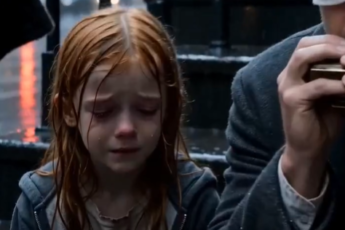
Maya Bennett waited foreground-right near the curb in a lightweight wheelchair, small and still against the wet road. She was seven, with strawberry-blonde curls held by a pink hair clip, freckled cheeks, and gray-blue eyes that did not fear the motorcycles. An ivory dress lay over her knees. A pale blue cardigan framed her shoulders. In her hands, she held yellow tulips, white daisies, and red flowers.
Caleb braked first.
His heavy boot touched wet pavement. The bike line stopped behind him, engines idling beneath ocean wind, no pileup, no crowding. His riders stayed rear-left behind their machines, silent and respectful.

Caleb dismounted.
At first, his face stayed guarded. He took two measured steps toward Maya from screen-left, stopping with clear space between himself and her chair. The sea wind moved the petals. His eyes lowered to the bouquet, and something in his chest tightened.
Maya raised the flowers.
The camera dropped into a low kneeling profile. Caleb lowered himself onto one knee at screen-left, one boot flat on the wet street. He did not touch her wheelchair. He removed one black glove slowly, leaving his bare hand open.
“I brought these because you looked like you missed somebody,” Maya said.
The engines seemed quieter.
Caleb’s breath caught.
He accepted the bouquet with his bare hand, holding the stems as if they might break. Damp leather darkened around his shoulders. His dog tag shifted. His green eyes moved from the tulips to Maya’s face, then away again, because the resemblance hit him too sharply.
Maya watched him with quiet certainty.
Behind Caleb, the riders lowered their heads. None of them spoke. The street remained open around the chair: motorcycles left, girl right, bouquet between them.
Caleb reached into his vest.
His hand shook only once.
He drew out a worn photograph, its corners soft from years of being unfolded and put away again. The shot tightened. In the picture, a little girl stood in a white dress, light curls around her face, smiling into sunlight. No readable marks, no dates, no names. Only the face. Only the smile.
Caleb stared at it.
His eyes filled before he could stop them.
“She had the same smile,” he whispered.
Maya did not ask who.
Caleb held the photograph beside the bouquet. The tulips brushed the old picture. For one breath, past and present sat in his hands together: one girl gone, one girl waiting; one memory folded from grief, one gift bright in the sea air.
A tear slid into his beard.
The oldest rider behind him turned his face away. Another closed both hands around his helmet. The engines idled, low and rough, but the convoy had become still.
Maya’s fingers tightened on the wheelchair armrest. “Are they okay?”
Caleb looked at her then.
His face broke into something more human than the hard mask he had worn down the road. He nodded once.
“They’re perfect,” he said.
The word nearly failed him.
He folded the photograph with care and kept it in his bare hand. Then he lifted a small radio to his mouth while still kneeling, the bouquet pressed gently against his chest. His eyes stayed on Maya, but his voice went to the riders.
“Riders, move out,” Caleb said. “We finish this for her.”
The crew behind him straightened as one. Helmets rose. Engines deepened. No one rushed forward. No one touched Maya’s chair. Respect stayed in the spacing, in the way the motorcycles held their line and waited for the command.
Caleb lowered the radio.
For years, he had believed the memorial ride was only for the daughter he lost. A road. A date. A line of engines across a grieving coast. But Maya had stopped him without raising her voice, seen the heartbreak beneath leather and noise, and placed color into his hands.
He stood slowly.
The bouquet stayed in his bare hand. The photo remained against the stems. Maya watched him rise, smiling softly, as if she had done what she came to do.
Caleb turned toward the motorcycles, but before he walked back, he bowed his head to her once.
The final frame held Maya foreground-right near the curb, wheelchair steady, petals moving in the sea wind; Caleb screen-left with the bouquet and worn photo between them; riders rear-left behind their bikes, engines waiting; wet asphalt reflecting wheels and sky. Before the memorial route could appear, the street faded into black.